
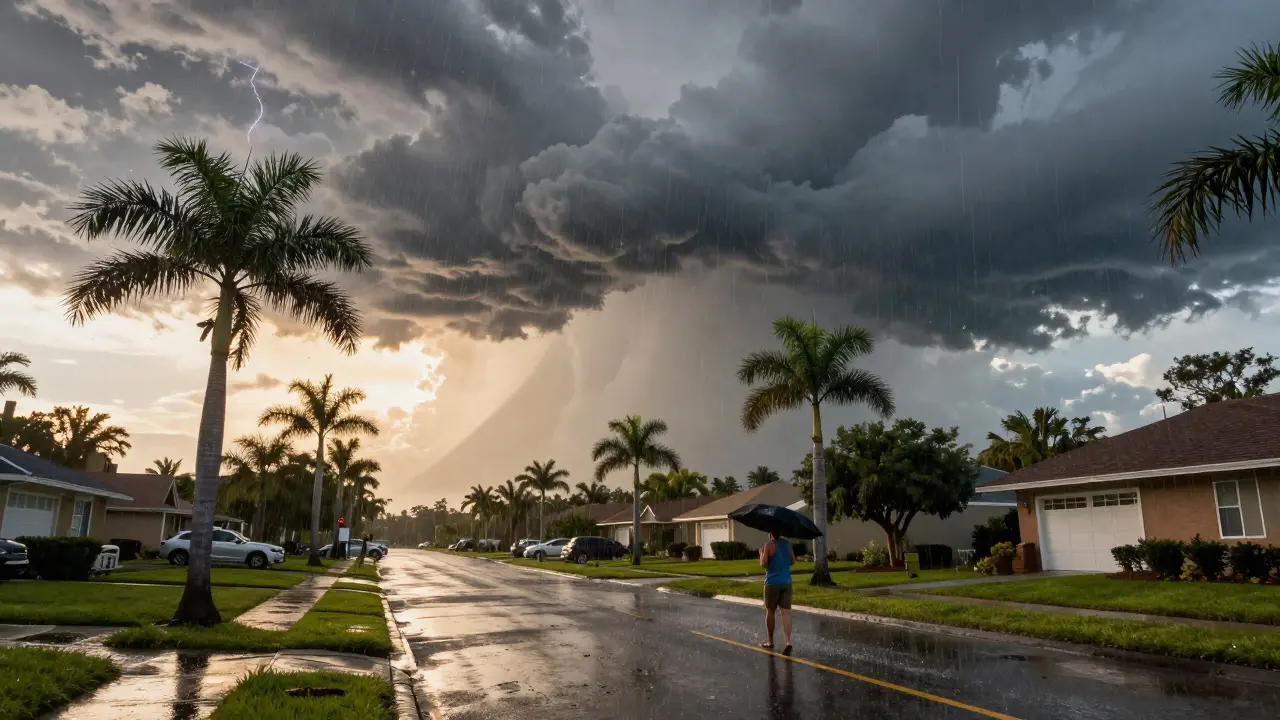
If you’ve ever planned a trip to Kissimmee, Florida, and got caught in a sudden downpour, you know it’s not just a quick shower-it’s a full-blown tropical deluge. So what’s the real deal with Florida’s rain? Which month gets the most of it? And why does it feel like the sky opens up every afternoon in summer?
The answer is simple: June is Florida’s rainiest month, especially in Kissimmee. On average, the area gets around 8.7 inches of rain in June. That’s more than any other month of the year. But it’s not just about the number-it’s about how the rain behaves. In June, storms roll in like clockwork, usually between 2 p.m. and 6 p.m., often lasting just an hour but dumping enough water to flood parking lots and turn sidewalks into streams.
This isn’t random weather. It’s tied to Florida’s unique climate. Kissimmee sits in the heart of Central Florida, surrounded by wetlands, lakes, and the Everglades’ eastern edge. The land heats up fast in late spring, and with humidity levels often hitting 90%, the air becomes a giant sponge. When that warm, moist air hits cooler air masses moving in from the Gulf or Atlantic, it rises quickly and forms thunderstorms. These aren’t the kind of storms you get in the Midwest. These are heat-triggered, short, intense, and frequent. They’re called convectional thunderstorms, and they’re the reason you’ll see locals checking the sky at noon and grabbing their umbrellas before lunch.
June beats July and August, which also get heavy rain, because it’s the first month when the atmosphere fully turns on the spigot. By July, the rain is still heavy-around 8.1 inches-but the storms start to shift. They become less predictable, sometimes skipping entire days, then dumping two inches in 20 minutes. August sees similar totals, but by then, the risk of tropical systems increases. Hurricanes and tropical storms can bring massive rainfall in a single day, but they’re rare. June’s rain? It’s reliable. It’s daily. It’s part of the rhythm of life here.
For visitors, this means planning matters. If you’re heading to Disney World or the nearby attractions in Kissimmee, don’t assume morning means clear skies. Pack a lightweight rain jacket, a foldable umbrella, and waterproof shoes. Most indoor attractions-like the Disney parks, air-conditioned museums, and shopping centers-can handle a midday storm just fine. But outdoor activities? Golf, kayaking, or a stroll through the Lake Tohopekaliga trails? Those can get canceled fast. Local tour operators know this. Many offer rain guarantees or flexible rescheduling for June bookings.
What about the rest of the year? Florida’s dry season runs from November through April. Rainfall drops to under 2 inches per month. That’s when you’ll see the highest number of tourists-because the weather feels perfect. But here’s the twist: the dry season isn’t dry everywhere. The Florida Keys and Miami can still get afternoon showers, just not like Kissimmee. In fact, Kissimmee gets more rain than Orlando, Tampa, or even Miami during the peak months. Why? Its inland location traps heat and moisture better than coastal areas. The sea breeze that cools down Miami doesn’t reach Kissimmee as strongly, so the heat builds, and the storms build with it.
Residents don’t complain about June rain-they’ve learned to live with it. Backyards flood, but they’ve got drainage systems. Pools get covered, but they’re cleaned the next day. Kids play inside, then head out to splash in puddles after the storm passes. The rain isn’t a nuisance-it’s a necessity. It fills the aquifers, feeds the lakes, and keeps the orange groves alive. Florida’s agriculture, especially citrus, depends on this seasonal pattern. Without June’s heavy rain, the state’s economy would suffer.
And here’s something most tourists don’t realize: the rain cools things down. After a storm, the temperature drops 10 to 15 degrees in minutes. The air smells fresh. The humidity drops. It’s the only real relief you get from the 90-degree heat. That’s why locals say, “The rain is Florida’s AC.” You don’t need to turn on the fan when the sky opens up-it does it for you.
So if you’re wondering when to avoid Kissimmee because of rain, the answer isn’t as simple as “summer.” June is the wettest, yes-but it’s also the most alive. The grass is greener, the alligators are more active, and the water parks are less crowded because everyone’s waiting for the storm to pass. If you’re flexible, you can still have a great trip. Just schedule your outdoor plans for the morning, and treat the afternoon as a time to chill indoors with a cold drink and a good book.
There’s no point in fighting it. Florida’s rain isn’t a flaw-it’s a feature. And if you’re visiting Kissimmee in June, you’re not getting rained on-you’re experiencing one of the most powerful natural cycles in North America.
What months are the wettest in Kissimmee?
June is the top, but the top five wettest months in Kissimmee are all back-to-back:
- June - 8.7 inches
- July - 8.1 inches
- August - 8.0 inches
- September - 7.9 inches
- May - 6.5 inches
That’s a five-month stretch where you’re almost guaranteed daily thunderstorms. Outside of this window, rainfall drops sharply. December averages just 2.2 inches. January and February hover around 2.5 inches. The difference is dramatic.
Does it rain all day in June?
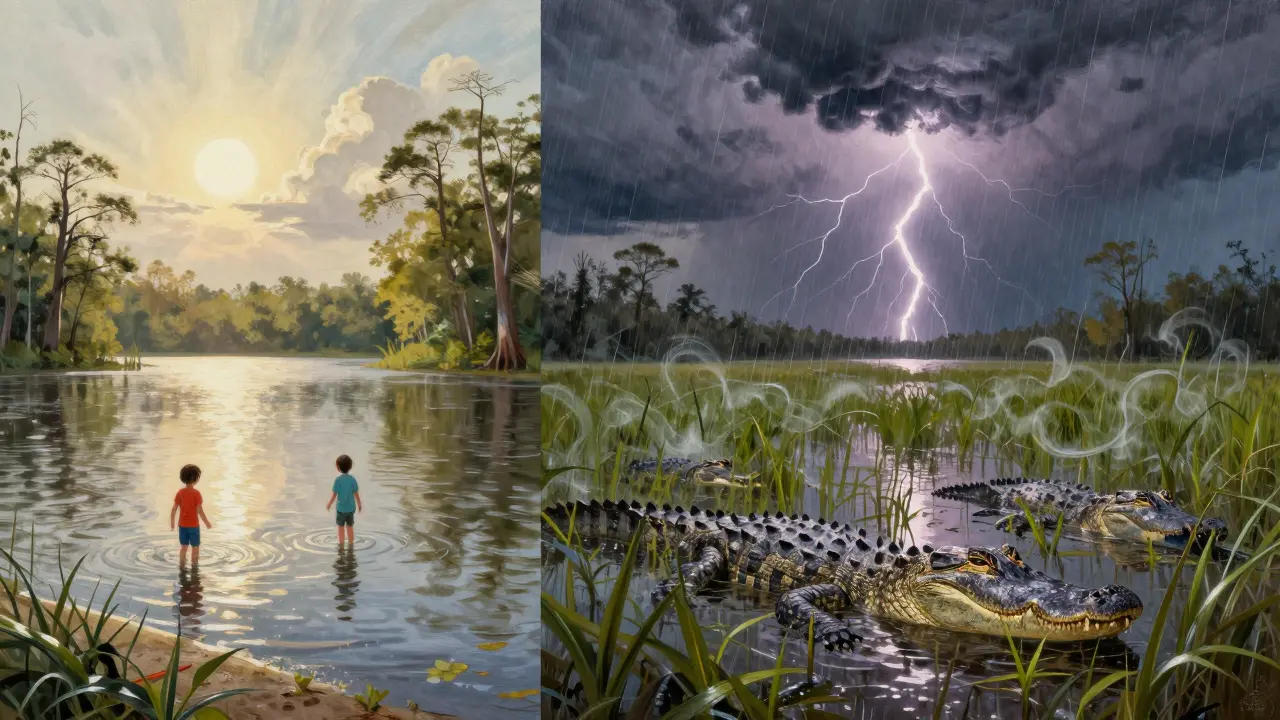
No. Most storms last 30 to 60 minutes. You’ll get a heavy downpour, a few loud claps of thunder, then clear skies again. It’s rare to have all-day rain in June. What you do get is a pattern: sunny morning, building clouds by noon, thunderstorms by 3 p.m., clearing by 7 p.m. It’s so consistent that locals call it the “afternoon reset.”
Is June the best time to visit Kissimmee?
It depends on what you want. If you want low crowds and lower prices at hotels and theme parks, June is a smart pick. Many families avoid it because of the rain, so you’ll find better deals. But if you’re planning on spending all day outside-hiking, boating, or exploring nature trails-you’ll want to choose a drier month. For most visitors, the sweet spot is late April or early November, when it’s warm but not soaking wet.

Can you get hit by a hurricane in June?
Technically, yes-but it’s rare. The Atlantic hurricane season runs from June 1 to November 30, but most storms form after mid-August. June hurricanes are uncommon. The water in the Atlantic isn’t warm enough yet to fuel major systems. So while you might get a tropical depression or a heavy rainstorm from a distant system, a direct hurricane hit in June is unlikely. July through October is when you need to pay attention to weather alerts.
How does Kissimmee’s rain compare to other parts of Florida?
Kissimmee gets more rain than Orlando, Tampa, or Jacksonville, but less than the Florida Keys or the Panhandle. The Keys average over 9 inches in June because they’re surrounded by water. The Panhandle gets heavy rain too, but from different systems-like cold fronts pushing in from the north. Kissimmee’s rain is pure heat and humidity. It’s the most consistent, the most daily, and the most predictable in the state.
What is Florida’s rainiest month?
June is Florida’s rainiest month, especially in Kissimmee, where it averages 8.7 inches of rainfall. This is due to intense afternoon thunderstorms fueled by heat and high humidity. July and August are close behind, but June has the highest average.
Why does it rain so much in Kissimmee in June?
Kissimmee’s inland location traps heat, and with humidity levels often above 90%, the air rises quickly and forms powerful thunderstorms. These are called convectional storms and happen almost daily in June as the land heats up and meets moist air from the Gulf and Atlantic.
Does it rain all day in June in Kissimmee?
No. Rain usually comes in short, heavy bursts between 2 p.m. and 6 p.m., lasting 30 to 60 minutes. The rest of the day is often sunny. This pattern is so consistent that locals plan their outdoor activities around it.
Is June a good time to visit Disney World in Kissimmee?
Yes-if you’re flexible. June has fewer crowds and lower hotel prices. Most Disney attractions are indoors or covered, so rain doesn’t ruin your day. Just plan outdoor activities for the morning and use the afternoon for indoor breaks or shopping. Many resorts offer rain guarantees for tours.
How does Kissimmee’s rainfall compare to Miami’s?
Kissimmee gets more consistent daily rain in June than Miami. Miami’s rain comes from tropical systems and sea breezes, which are less predictable. Kissimmee’s rain is driven by heat, making it more regular and intense during the afternoon. However, Miami gets more total annual rainfall due to hurricanes and coastal storms.
Teja kumar Baliga
January 4, 2026 AT 23:08Just got back from Kissimmee last month and yeah, the 3 p.m. storms are real. I packed a raincoat, grabbed an ice cream, and waited it out inside. Best part? The air smells like fresh earth after. Florida’s AC, baby.
Mongezi Mkhwanazi
January 6, 2026 AT 11:48June? Are you serious? That’s not ‘rainiest’-that’s ‘atmospheric collapse’! Eight-point-seven inches? That’s not precipitation-it’s a sustained hydrological assault! And you call it ‘predictable’? Predictable?! The humidity doesn’t just rise-it *suffocates*-and then-WHAM!-the sky ruptures like a ruptured bladder-and you’re just… standing there… holding a soggy umbrella… like a passive participant in nature’s tantrum…
Nicholas Zeitler
January 7, 2026 AT 10:35Don’t forget to check the radar app before heading out! I’ve seen people get soaked because they trusted ‘sunny forecast’ at 11 a.m.-big mistake. Storms form FAST. Always have an indoor backup plan. And yes, Disney’s covered walkways are lifesavers.
lucia burton
January 8, 2026 AT 17:04Let’s not mischaracterize this as mere meteorological variance-it’s a climatological imperative driven by latent heat flux convergence over the Peninsular Aquifer Basin, amplified by the thermal inversion layer anchored by the Everglades’ evapotranspiration matrix. June is not a month-it’s a phase transition in atmospheric dynamics. The ‘afternoon reset’? That’s the troposphere’s homeostatic recalibration. You’re not getting rained on-you’re participating in a planetary cooling protocol.
Zelda Breach
January 8, 2026 AT 19:32Oh please. They say June is the rainiest-but have you checked the data from NOAA’s satellite archives? The ‘8.7 inches’ is inflated because they count every drop that hits a sensor-even the mist from a sprinkler. Real rainfall? Maybe 5 inches. The rest is tourism marketing. And don’t even get me started on ‘convectional storms’-that’s just a fancy word for ‘hot air bubble pops’.
adam smith
January 9, 2026 AT 03:45June is the rainiest month. That's all you need to know.
Kelley Nelson
January 9, 2026 AT 17:33How quaint. To refer to a tropical convective system as ‘Florida’s AC’-as if nature were a domestic appliance designed for tourist convenience. The romanticization of meteorological inevitability is not only reductive, it’s culturally infantilizing. One does not ‘experience’ a climatological phenomenon when one is merely enduring it with a foldable umbrella purchased at a gift shop.
Aryan Gupta
January 11, 2026 AT 12:45Wait… why is Kissimmee getting more rain than Miami? Coincidence? Or is this a covert water diversion program by Disney to keep their underground aquifers full? They own half the land here. They control the drainage. The ‘daily storms’? They’re triggered by underground pumps. I’ve seen the drones. I’ve seen the patterns. June isn’t natural-it’s engineered. And they’re hiding it behind ‘convectional storms’ nonsense.
Alan Crierie
January 11, 2026 AT 14:42Just wanted to say-this post was so well written. I’m from the UK and I’ve never been to Florida, but now I feel like I’ve walked through those afternoon storms. The way you described the smell after rain? That’s poetry. And the bit about locals treating it as a rhythm? That’s beautiful. Thank you for sharing your home like this.
Tiffany Ho
January 11, 2026 AT 22:52My dad always said if you’re gonna visit Florida in June bring a towel and a good book. He was right. We spent half our trip inside watching cartoons and the other half running between buildings. But the pool at our hotel was empty after the storms and the kids had the whole thing to themselves. Best vacation ever.
k arnold
January 12, 2026 AT 03:00So June’s the rainiest? Wow. Groundbreaking. Next you’ll tell me the sun rises in the east. Did you also notice that water is wet? And that people who live here don’t die from it? Shocking. I’m sure this took three weeks of research and three espresso shots.
Gareth Hobbs
January 13, 2026 AT 07:07Yeh well, over here in Blighty we get rain every day and no one calls it ‘nature’s AC’-we just call it ‘weather’. And you lot act like it’s some mystical ritual. It’s just clouds. And if you’re complaining about 8 inches, you’ve never seen a proper British downpour. Or maybe you just like the drama. It’s all very… Disney.
Mark Nitka
January 15, 2026 AT 02:52I get why people hate the rain-but it’s what keeps Florida alive. No June storms, no oranges. No oranges, no juice. No juice, no breakfast. No breakfast, no tourists. No tourists, no economy. It’s not a flaw, it’s the foundation. Stop seeing it as an inconvenience and start seeing it as a gift. The land’s giving you water, shade, and a reason to slow down. That’s worth more than a perfect sunny day.
Fredda Freyer
January 16, 2026 AT 17:53The real magic isn’t the rain-it’s how people adapt. Kids splash in puddles. Farmers plan harvests around it. Tourists learn to love the pause. It’s not about avoiding the storm-it’s about learning its rhythm. That’s what makes a place not just livable, but meaningful. Florida doesn’t fight the rain. It dances with it. And that’s a lesson the whole world could use.
michael Melanson
January 17, 2026 AT 10:45I’ve been to Kissimmee three times in June. Every time the same thing: sunny till 2, storm at 3:15, clear by 6. It’s like clockwork. I’ve stopped checking the weather app. I just look at the sky at noon. If the clouds are puffing up like cotton balls? Grab the umbrella. If not? Go for it. Works every time.