
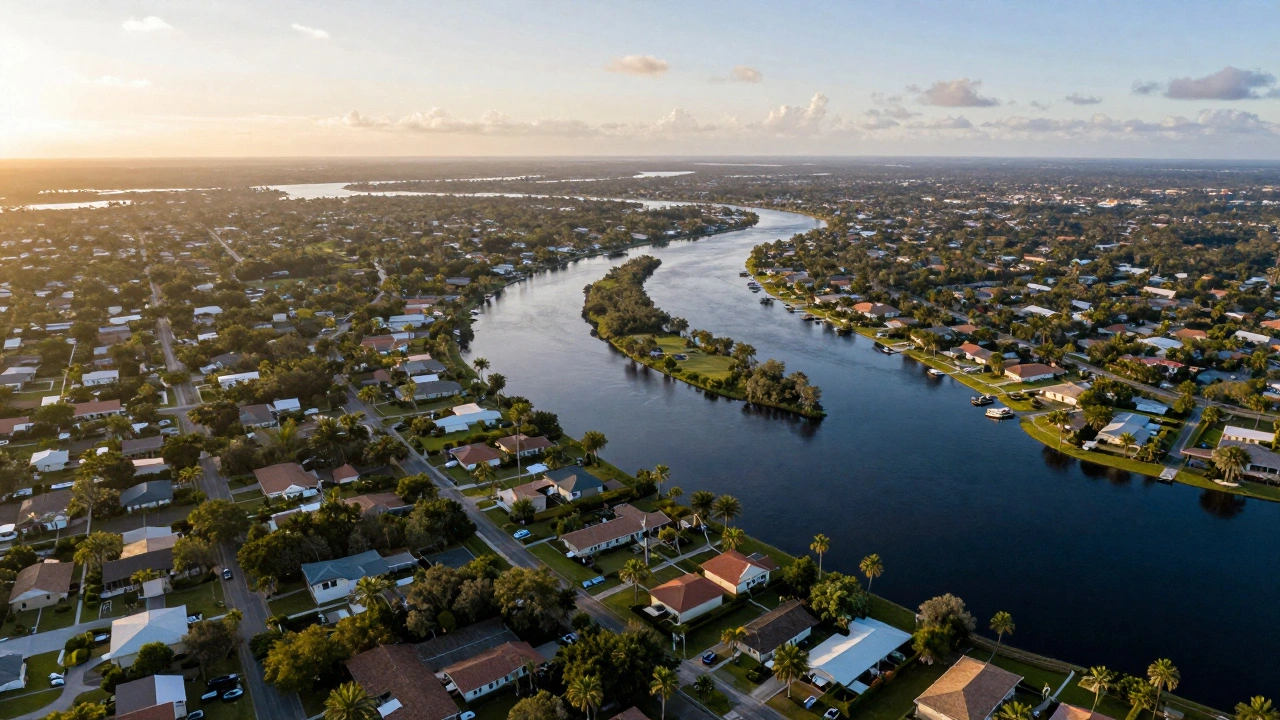
If you’re thinking about moving to Florida, you’ve probably heard the warnings: hurricanes, sinkholes, rising insurance costs. The truth is, not all of Florida is equally risky. Some areas sit on solid limestone bedrock, far from the coast, and rarely see storm surge or flooding. Others? They’re sitting on a time bomb of dissolved limestone waiting to collapse under your driveway. The goal isn’t to find a place with zero risk-it’s to find the place with the least.
Why Kissimmee Stands Out
Kissimmee sits about 20 miles west of Orlando, tucked between Lake Tohopekaliga and the Kissimmee River. It’s not on the coast. It’s not near the Gulf of Mexico. And it’s not in the classic sinkhole belt that runs from Tampa Bay to Daytona Beach. That alone puts it ahead of most of the state.
Since 2000, Osceola County-where Kissimmee is located-has recorded fewer than 15 major sinkhole claims per year on average, according to Florida’s Office of Insurance Regulation. Compare that to Hillsborough County (Tampa), which sees over 200 claims annually. Kissimmee’s geology is older, more compacted limestone with fewer underground cavities. It’s not sinkhole-proof, but it’s far less likely to swallow your garage.
When it comes to hurricanes, Kissimmee’s inland location cuts risk dramatically. Storms like Ian (2022) and Irma (2017) dumped rain and knocked out power here, but they didn’t bring 100+ mph winds or coastal flooding. The worst you’ll usually face is heavy rain and scattered tree damage. The average wind speed during a hurricane’s impact in Kissimmee is around 50-60 mph-far below the 110+ mph you’d see in Miami or Naples.
Other Safe Areas in Central Florida
Kissimmee isn’t alone. If you’re looking for similar safety, check out these nearby towns:
- Winter Haven - Located on the Polk County ridge, it’s one of the highest-elevation areas in central Florida. The bedrock here is denser, and sinkhole claims are half the state average.
- Lake Wales - Sitting on the Lake Wales Ridge, this town has some of the oldest, most stable limestone in the state. Only 3 major sinkholes were reported here between 2015 and 2024.
- Apopka - North of Orlando, it’s far enough from the coast to avoid major storm surge. It’s also outside the main sinkhole corridor, though it’s seen a few more incidents than Kissimmee due to older plumbing and soil conditions.
- DeLand - In Volusia County, it’s about 50 miles from the Atlantic. The elevation is higher than most of Florida, and sinkhole activity is minimal.
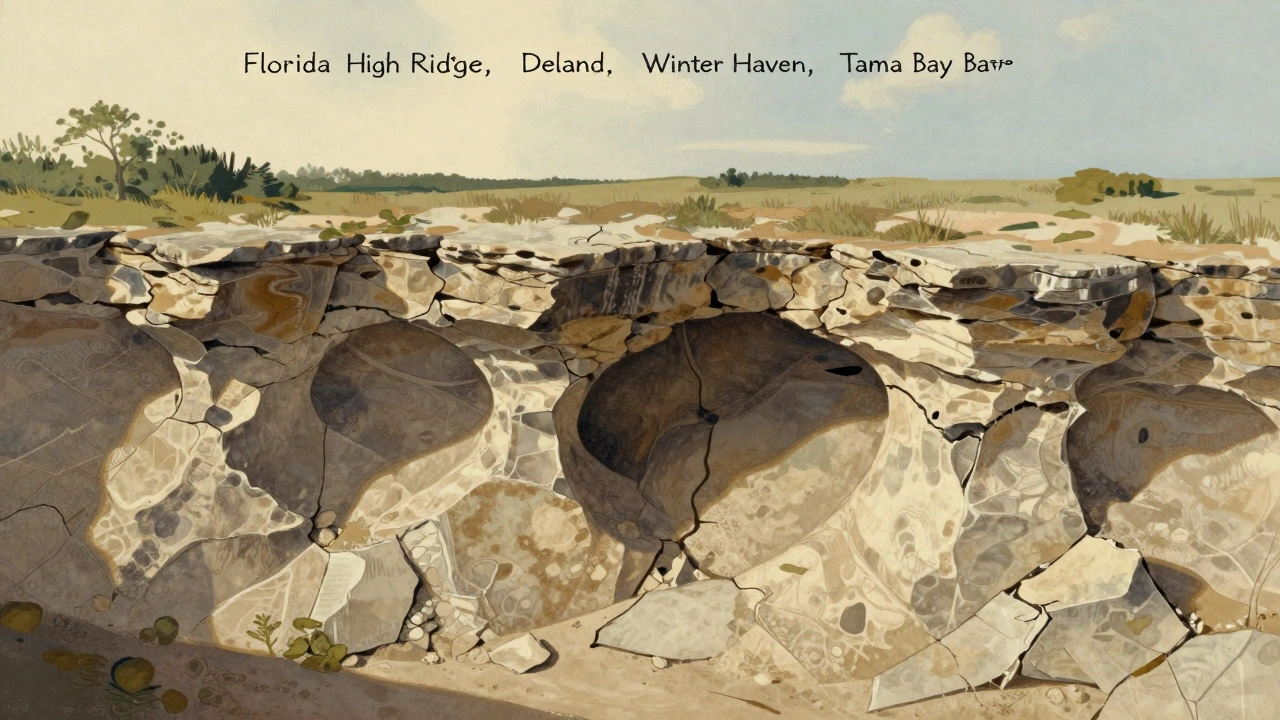
These towns all share one thing: they’re on the Florida High Ridge, a natural elevated band of land running from Tampa Bay to the St. Johns River. This ridge formed millions of years ago when sea levels were lower. The limestone here was exposed longer, compacted more, and developed fewer voids. That’s why sinkholes are rare.
What Makes a Place Unsafe?
Florida’s danger zones follow clear patterns. Avoid areas with:
- Coastal proximity - Any town within 15 miles of the Gulf or Atlantic coast faces direct hurricane threats. Storm surge can reach 10-15 feet even in Category 1 storms.
- Low elevation - Places like Fort Myers, Cape Coral, and Homestead sit just a few feet above sea level. They flood easily, even during minor storms.
- Older sinkhole hotspots - Tampa, St. Petersburg, Clearwater, and parts of Bradenton have seen over 1,000 sinkhole claims since 2010. Insurance companies here charge double the state average.
- High water table areas - If your yard floods after a heavy rain, the ground beneath it is saturated. That’s a recipe for sinkholes when the water drains away.
Even within safe areas, some neighborhoods are riskier than others. Look for homes built after 2000 on higher ground. Avoid properties near old quarries, drainage ditches, or areas where the ground has been dug up for construction. Old wells and septic systems can also weaken the soil.
Insurance Costs Tell the Real Story
Don’t just look at maps. Look at your wallet.
In Kissimmee, the average annual homeowner’s insurance premium in 2025 is $2,100. That includes wind and hail coverage. In Tampa, it’s $5,800. In Miami, it’s $9,200. And that’s before you add sinkhole coverage-which isn’t even required in Florida, but most people in high-risk areas buy it anyway.
Here’s the kicker: in Kissimmee, only 12% of homeowners carry separate sinkhole insurance. In Tampa, it’s 78%. That’s because insurers in Kissimmee rarely deny claims for structural damage-they don’t have to. The risk is just too low.
Also, flood insurance isn’t mandatory here unless you’re near a mapped floodplain. And even then, most of Kissimmee is outside those zones. In contrast, over 40% of homes in Fort Lauderdale are in high-risk flood zones.
What About Climate Change?
Some people worry that rising sea levels and stronger storms will make even inland areas unsafe. The data doesn’t back that up-not yet.
Florida’s hurricane landfall frequency hasn’t increased since the 1950s, according to NOAA. What has changed is the intensity of storms that do hit. But those strongest storms-Category 4 and 5-almost always make landfall on the coast. They weaken rapidly once they move inland. By the time they reach Kissimmee, they’re usually tropical storms.
As for sinkholes, climate change doesn’t cause them. Heavy rain and groundwater pumping do. And Kissimmee’s water usage is tightly regulated. The city gets its water from the Floridan Aquifer, but it’s drawn from deep wells with strict limits. There’s no over-pumping here like in parts of Tampa or Orlando.
What to Look for When Buying
If you’re house hunting in Kissimmee or nearby, here’s what to check:
- Ask for a sinkhole inspection - Even in low-risk areas, it’s worth $300-$500. A licensed geotechnical engineer can check for soil voids and subsidence.
- Check the property’s history - Use the Florida Department of Environmental Protection’s sinkhole database. Search by address. If there’s been a claim, find out what was done to fix it.
- Look at the foundation - Cracks wider than 1/8 inch, uneven floors, or doors that stick suddenly could signal settling. Not always a sinkhole, but worth investigating.
- Verify flood zone status - Use FEMA’s Flood Map Service Center. If the property is in Zone X (low to moderate risk), you’re in a good spot.
- Ask about insurance rates - Get quotes before you make an offer. If the seller says “it’s cheap here,” ask for proof.
Also, avoid homes built before 1980 with slab foundations. Older homes often lack proper drainage and were built over unknown fill dirt. Newer homes (post-2010) usually have engineered footings and better drainage systems.
Real-Life Example: The Smith Family
In 2021, the Smiths moved from Clearwater to Kissimmee after their home in Clearwater was damaged by a sinkhole. Their insurance paid $120,000 to repair the foundation-but they lost $80,000 in equity because their home’s value dropped. They bought a new 2,400-square-foot home in Kissimmee for $320,000. Their annual insurance? $1,900. In Clearwater, it was $6,100. They’ve lived there for four years. No issues. No claims. No stress.
That’s the difference.
Bottom Line
Kissimmee isn’t perfect. It gets rain. It gets wind. It’s not immune to nature. But compared to the rest of Florida, it’s one of the safest places to put down roots. The sinkhole risk is low. The hurricane risk is manageable. Insurance is affordable. And you’re still 15 minutes from Disney World, great schools, and major highways.
If you want to live in Florida without constantly worrying about your house vanishing into the ground or your roof flying off in a storm, Kissimmee and nearby towns on the Florida High Ridge are your best bet.
Is Kissimmee Florida safe from hurricanes?
Yes, Kissimmee is relatively safe from direct hurricane impacts. It’s about 20 miles inland from the Atlantic coast, so it avoids storm surge and the strongest winds. While it can still get heavy rain and power outages during storms, it rarely sees sustained winds over 70 mph. Hurricanes weaken significantly before reaching Kissimmee, making it one of the safest inland areas in Florida.
Are there sinkholes in Kissimmee?
Sinkholes do occur in Kissimmee, but they’re rare compared to other parts of Florida. Osceola County averages fewer than 15 major sinkhole claims per year, while places like Tampa see over 200. The bedrock under Kissimmee is older and more compacted, reducing the chance of underground cavities forming. Most homes here don’t need separate sinkhole insurance.
What part of Florida has the fewest sinkholes?
The Florida High Ridge-running through Kissimmee, Winter Haven, Lake Wales, and DeLand-has the fewest sinkholes. This elevated band of land has dense, ancient limestone that formed millions of years ago and developed fewer underground voids. Areas like Tampa, Clearwater, and St. Petersburg sit on younger, more porous limestone and have far higher sinkhole rates.
Is it cheaper to live in Kissimmee than coastal Florida?
Yes, significantly. The average annual homeowner’s insurance in Kissimmee is $2,100, compared to $5,800 in Tampa and $9,200 in Miami. Home prices are also lower-median home value is around $320,000, while coastal cities often exceed $500,000. Property taxes are similar, but insurance and repair costs are much lower.
Should I get sinkhole insurance in Kissimmee?
It’s not required, and most residents don’t buy it. The risk is low enough that insurers rarely pay out claims here. If you’re buying a newer home built after 2010 on stable ground, you’re likely fine without it. But if you’re considering an older home or property near a drainage ditch, spending $300-$500 on a geotechnical inspection is a smart move before skipping coverage.
What should I look for when buying a home in Kissimmee?
Check for foundation cracks wider than 1/8 inch, uneven floors, or doors that stick. Ask for a sinkhole inspection ($300-$500) and review the property’s history in the Florida DEP sinkhole database. Make sure the home is outside FEMA flood zones and built after 2000. Avoid homes near old quarries, wells, or areas with recent excavation.
ujjwal fouzdar
December 6, 2025 AT 03:29So we’re just supposed to believe that Kissimmee is some kind of Florida utopia? What about the fact that climate change is rewriting the rules? The aquifer’s dropping, the soil’s shifting, and the state’s been lying to us for decades about ‘low-risk’ zones. This isn’t safety-it’s a marketing brochure dressed up as geology.
I lived in Winter Haven for three years. My neighbor’s house just collapsed last year. No warning. No claim. Just a hole where his garage used to be. They’re not reporting all the sinkholes. The insurance companies bury them.
And don’t get me started on ‘affordable insurance.’ That $2,100 number? That’s before they raise it by 40% next year because they’ve got to cover the other 90% of the state. You think you’re safe? You’re just the next guy they’ll screw when the next ‘unprecedented storm’ hits.
This whole post feels like a real estate ad written by someone who got paid in timeshares.
Anand Pandit
December 7, 2025 AT 04:53I moved to Kissimmee last year from Tampa after my insurance hit $7k/year. Best decision ever. My house is 2007, slab foundation, and I got a free sinkhole inspection with the purchase-zero issues. Rain comes, power goes out sometimes, but no cracks, no sinking, no panic.
Just do the basics: check the DEP database, get a good inspector, avoid old homes near drainage ditches. It’s not magic, it’s just smarter than living in a sinkhole lottery.
And yes, Disney’s 15 minutes away. You get peace of mind AND Mickey Mouse. Win-win.
Reshma Jose
December 8, 2025 AT 13:13Ugh I’m so tired of people acting like Florida is a death trap. Yeah, the coast is wild, but central Florida? Chill. I’ve lived in Lake Wales for 8 years. Only thing I’ve lost to nature? A mailbox during a thunderstorm.
My cousin in Naples? Her roof got torn off in Ian. I got a tree branch on my fence. That’s the difference.
And insurance? I pay $1,800 a year. Full coverage. No sinkhole add-on. I’m not risking my life savings on a fear meme.
Stop scrolling. Go look at the data. Kissimmee’s not perfect, but it’s not a nightmare either. You can live here without needing a bunker.
rahul shrimali
December 10, 2025 AT 12:30Kissimmee good. Tampa bad. Move inland. Save money. Sleep better. Done.
Eka Prabha
December 10, 2025 AT 15:57The entire premise of this post is a classic case of neoliberal environmental obfuscation. By framing sinkhole risk as a localized geological anomaly, the narrative deflects attention from systemic failures in urban planning, aquifer depletion, and corporate-driven deregulation of groundwater extraction.
The Florida High Ridge is not a natural sanctuary-it’s a temporal artifact of Pleistocene topography, now exploited by real estate conglomerates to commodify false security. The 15 sinkhole claims in Osceola County? That’s the tip of the iceberg. Most are classified as ‘subsidence events’ to avoid triggering mandatory disclosure.
And let’s not forget: insurance premiums are artificially suppressed here because the state’s risk-modeling algorithms are still calibrated to pre-2010 hydrological data. Climate change has already altered precipitation patterns by 22% in central Florida since 2015, yet the DEP’s maps haven’t been updated.
This isn’t safety. It’s statistical manipulation wrapped in a cozy suburban fantasy. You’re not avoiding risk-you’re just delaying the inevitable.
And yes, I’ve reviewed the Florida DEP sinkhole database. The redacted entries are more telling than the published ones.
Bharat Patel
December 12, 2025 AT 06:49There’s something poetic about how we keep looking for perfect places to live, as if nature owes us safety. We build our homes on ancient seabeds, then get mad when the earth remembers it used to be underwater.
Kissimmee isn’t safe because it’s special-it’s safe because it’s old. The rock there has had time to settle, to harden, to become quiet. It’s not a miracle. It’s just time.
But here’s the thing: every place has its price. The coast pays with storms. The sinkhole zones pay with fear. Kissimmee pays with boredom-no ocean views, no beach parties, no constant drama.
Maybe the real question isn’t where to live, but what kind of life you’re willing to trade for peace. I think Kissimmee offers a quiet kind of freedom. Not the flashy kind. The kind that lets you sleep through the night.
Bhagyashri Zokarkar
December 12, 2025 AT 18:37okay so i moved to kissimmee last year and i swear to god i think my house is slowly sinking like in that movie where the ground eats everything and i dont even know if its real or if im just paranoid but my door keeps sticking and my floor is like… tilted? and i asked my landlord and he was like oh thats normal in florida but then i saw this post and now im crying in my kitchen at 3am wondering if i made a huge mistake and my cat is judging me and i just wanted a nice house not a geological time bomb
also why does everyone keep saying insurance is cheap like i paid 2k but my deductible is 10k and if a sinkhole swallows my fridge do i get a new one or just a really sad receipt
also i think the government is hiding something about the aquifer i read a blog once that said they pump water out and replace it with saltwater and now the ground is dissolving from the inside and i think they know but they dont tell us because tourism
Rakesh Dorwal
December 13, 2025 AT 16:12Florida’s safe zones? Please. This is all part of the globalist agenda to make us move inland so they can control our water and food supply. The real reason Kissimmee looks safe is because the feds are monitoring it with satellite drones to track population shifts.
And don’t believe that ‘low insurance’ nonsense. That’s just the bait. Once you’re settled, they raise rates, then they take your land for ‘infrastructure projects.’
Wake up. The coast is dangerous, yes. But the inland? It’s a trap. They want you isolated. Quiet. Easy to control.
And who wrote this post? A realtor? A lobbyist? A CIA asset? Check the domain. I did. It’s registered to a shell company in Delaware.
Vishal Gaur
December 14, 2025 AT 14:19So i read this whole thing and i think its kinda right but also kinda not? like i live in apopka and yeah no major sinkholes but last year my neighbor had a little dip in the backyard and they filled it with concrete and now its like a mini pond after rain? and i think the insurance thing is true but my cousin in miami pays 12k and its still not enough so i dunno
also the part about homes built after 2010? mine was 2008 and its fine but my foundation has a crack the size of a pencil and i just ignore it because i dont wanna spend 500 bucks on some geologist who might say ‘oops your house is a time bomb’ and then i lose my mortgage
and why is everyone so obsessed with sinkholes? its not like we’re living on a volcano. its just dirt. it moves. it always has. we just got used to pretending it won’t.
also i think kissimmee is fine but i’d still get the inspection. just in case. my dog pees on the same spot every day and i swear the grass is dying faster now. maybe its the sprinklers. maybe its the end times. who knows.
Nikhil Gavhane
December 15, 2025 AT 12:44I appreciate this breakdown. I’ve been considering a move to Florida from Ohio, and the fear of hurricanes and sinkholes kept me paralyzed. This actually gave me a clear path forward.
My parents lost their home to a sinkhole in Georgia years ago-just a small one, but the damage was enough to make them move. I never want that feeling again.
Kissimmee, Winter Haven, Lake Wales-they all sound like places where you can breathe. Where you don’t have to check the weather app like it’s a bomb timer.
Thank you for the practical advice. The insurance numbers, the DEP lookup, the foundation tips-they’re exactly what someone like me needs to feel confident, not scared.
It’s not about perfection. It’s about peace. And that’s worth more than a beach view.
Rajat Patil
December 17, 2025 AT 11:02It is with great consideration that I reflect upon the proposition presented herein. The geographical and geological parameters outlined are both methodical and empirically supported, as evidenced by the comparative data provided by the Florida Office of Insurance Regulation and NOAA.
One must acknowledge, however, that human perception of safety is often influenced by relative experience rather than absolute risk. The Smith family’s narrative, while anecdotal, exemplifies a paradigm shift from reactive to proactive residential decision-making.
Furthermore, the distinction between regulatory compliance and actual structural integrity remains a critical factor in property acquisition. The recommendation to consult the Florida Department of Environmental Protection’s database is not merely prudent-it is ethically imperative.
In conclusion, while no location may be entirely devoid of natural hazard, the Florida High Ridge presents a statistically optimal compromise between accessibility, affordability, and long-term resilience. One may reasonably conclude that this region constitutes a rational choice for those seeking to establish permanent habitation within the state.
Anand Pandit
December 18, 2025 AT 02:35Love this. My sister just bought in Winter Haven and did the inspection. Found a tiny void under the back porch-$800 to fill it. Now she’s got peace of mind for the next 20 years. Small cost for big peace.
And yeah, the ‘it’s just dirt’ crowd? They’re the ones who end up calling 911 when their garage disappears.